
Fighting odours
Odour nuisance and odour control
Nuisance caused by odours and gases is a major problem for both employees and the surrounding environment. Odorous gases can seriously spoil quality of life and working conditions, or even be harmful to people and the environment.
The most common sources of odour we encounter are sulphides (H2S), ammonia (NH3), and volatile organic compounds (VOCs). Which substance is responsible for the nuisance varies strongly by market and sector. In industry, VOCs are very common, often originating from solvents and chemical compounds. In water treatment and wastewater treatment — at companies as well as municipalities and water authorities — and at sewage pumping stations, H2S is the main culprit. In the meat processing industry and the food industry, too, decomposition and production processes regularly cause odour complaints from the surrounding area.
Most common sources of odour by industry
Because every sector has its own odour sources and gas composition, odour control always calls for an industry-specific approach. In industry and wherever solvents are used, capturing VOCs is the main focus, while at wastewater treatment plants, sewage pumping stations, and the meat processing industry, H2S and ammonia are the key concerns. Take a look at our solutions for the various industries we serve. This industry-specific knowledge determines not only which filter medium is the best fit, but also how the extraction and filtration system should be designed.
Definition of odour nuisance and odour annoyance
There is a distinction between the definitions of odour nuisance and odour annoyance. Odour nuisance is expressed in odour units per cubic metre of air that reaches people's homes. This quantity can be measured or calculated. Odour annoyance is the cumulative result of repeated exposure to odour in the living environment. Because of this recurring nuisance, odour annoyance can cause health issues and even psychological complaints.
How odour annoyance is experienced is also subjective and depends on the individual. The smell of a bakery may initially come across as pleasant, but anyone exposed to it every day will often start to find it bothersome after all. On top of that, people today are more vocal and more critical of odour nuisance from their surroundings than in the past, when entire neighbourhoods and communities were economically and socially tied to a nearby factory or industry. That social tolerance has declined, while laws and regulations on odour annoyance and emission standards have become stricter.
Laws and regulations on odour annoyance
Exactly which odour and emission standards apply depends on a company's environmental permit, its location, and the underlying process. This includes regulations such as the Environmental Management Activities Decree (Activiteitenbesluit milieubeheer). Companies must be able to demonstrate that they stay within the permitted emission limits, for example to the regional environmental agency (omgevingsdienst). Allsorb Air Filter B.V. helps clients not only with the right filtration solution, but also with making the resulting odour and emission reduction measurable and demonstrable.


Odour control with Allsorb Air Filter B.V.
Allsorb Air Filter B.V. has extensive experience in odour control and emission management in, for example, the food industry, meat processing industry, hospitality, and wastewater treatment. That's why we understand the specific odour and emission issues that arise in these sectors, and we offer a broad range of filtration solutions for flow rates from 100 m3/h to 40,000 m3/h. We use activated carbon (impregnated or not) and/or chemical filters, which allow us to capture organic compounds (VOCs) and inorganic components (H2S, NH3, Hg, etc.).
For VOCs, we use virgin (non-impregnated) activated carbon filters: these organic compounds cannot be broken down chemically and are barely soluble, which is why a wet scrubber is not a solution here. VOCs are therefore physically adsorbed onto the carbon filter. For inorganic components such as H2S and ammonia, we use chemically impregnated carbon filters instead: here a chemical reaction takes place that is virtually irreversible. An acidic gas such as H2S is captured with a base-impregnated carbon, while a basic gas such as ammonia is captured with an acid-impregnated carbon. For very high concentrations and large air volumes, we also offer biological odour filters, together with a specialised partner. These withstand high concentrations and moisture well, but do require a stable, continuous airflow: under strongly fluctuating loads, biological filters are less reliable. Before recommending a filtration system, we therefore always map out the operating costs (OPEX): the expected service life, replacement frequency, and financial feasibility. If the load is too high for an economically viable service life with activated carbon, we may, for example, recommend a combination with a biological odour filter as a pre-treatment stage.
Decentralised versus centralised odour control
When designing an odour control installation, we deliberately choose a decentralised approach rather than the traditional, centralised one. In a centralised approach, all odour sources are connected via one extensive ductwork system to one large central filter. Because air always takes the path of least resistance, such a ductwork system has to be balanced down to the last detail — any adjustment at one point immediately affects the rest of the system. This makes a centralised installation expensive to build and vulnerable: if the fan or the central filter fails, the entire extraction system essentially comes to a halt.
In our decentralised approach, we connect each odour source, or a small cluster of sources with similar characteristics, to its own compact filter. This requires much simpler ductwork, is cheaper and faster to implement, and makes the installation less vulnerable to breakdowns. This approach also allows for phased investment: we first tackle the largest odour sources — the ones causing the most nuisance — and then expand step by step until all sources fall within the set emission limits.
Exactly what capacity is required is something we determine together with the client, based on our team's years, and in some cases decades, of experience in extraction and air handling technology. A good extraction system doesn't start with the filter medium, but with the way air is extracted: drawing off only as much air as needed to relieve the overpressure and create the right ventilation, rather than moving unnecessarily large volumes of air. Our largest single filter is suitable for a flow rate of 50,000 m3/h; by placing multiple filters in parallel or in series, we can also provide suitable solutions for very large airflows of up to 100,000 m3/h.
Practical odour control test
In cases where the gas composition and concentrations are unknown, Allsorb Air Filter B.V. offers the option of a practical test using a small-scale test filter on a partial airflow, to gain insight into the most suitable combination of media and an accurate estimate of service life (and therefore operating costs). After all, we believe it's important that you have a clear picture of the OPEX as well as the CAPEX!
A one-off gas analysis is always just a snapshot: the gas composition of, say, a flue duct or chimney can look completely different the very next day. That's why we often run a small test filter on a partial flow for a longer period, until the medium becomes saturated. This allows us to extrapolate the results to the actual load and service life, and to demonstrate concretely that the air still smells before the filter, and no longer does afterwards. For a one-off measurement, our gas analysis service can also provide that snapshot.
Rental Containers and Exchange Containers
Filtration systems from Allsorb Air Filter B.V. can be supplied on a rental basis or as an exchange unit, if desired. With the exchange unit, the filter with spent media is swapped for a unit containing fresh or regenerated medium, with Allsorb Air Filter B.V. taking care of all the necessary logistics.
Service
Allsorb Air Filter B.V. takes the hassle out of filter media replacement for its clients with a complete service programme. For exchanging media in filter drums, a suction truck is an indispensable tool for quickly and effectively changing the filter medium with minimal physical, gas, and fine-particulate strain on personnel.
Our service programme covers the entire logistics process: from removing the spent medium through to its environmentally responsible processing and disposal. Because we operate our own suction trucks, we're not dependent on the availability of external parties and can respond very quickly whenever an odour problem arises. For installations in residential areas, for example, we commit to resolving odour problems within one day. On top of that, exchanging filter medium with a suction truck is far more ergonomic for our staff than manual replacement.
Safety in odour control
Safety is critical when working with odour sources such as H2S. H2S is a silent killer: at higher concentrations you can no longer smell it, even though the substance can still be harmful or even lethal. From around 100 ppm, prolonged exposure is already harmful, and at concentrations of 500 to 1,000 ppm, H2S can be immediately fatal in practice. That's why we work with strict safety instructions: before our staff work on a filter or installation, the concentration is always measured first with a gas meter, and the correct personal protective equipment, such as dust masks, is used.
We can't wait to help you too!


 20 October 2025We are officially VCA certified!Reading time: 1 minute
An important milestone for us as a company, and a major step forward in further profession...
 14 February 2025Allsorb Air Filter and Odour Balance Join Forces at Aqua Nederland 2025Reading time: 2 minutes
Allsorb Air Filter and Odour Balance Join Forces at Aqua Nederland Trade Fair 2025
 20 October 2024Allsorb deploys new mobile filtration truckReading time: 2 minutes
Met trots kondigen wij aan dat Allsorb Air Filter BV heeft geïnvesteerd in een mobiele zui...
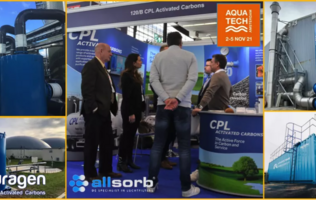 16 November 2021Allsorb Puragen CPLReading time: less than 1 minute
The recent Aquatech exhibition in Amsterdam was an excellent opportunity for meetings and ...
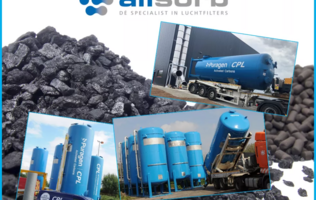 27 August 2021CPL/Puragen Activated Carbons Announce Partnership with Dutch Air Filtration Specialist AllsorbReading time: 1 minute
Netherlands-based air filtration OEM and installation specialist Allsorb has been appointe...


